
If you’ve searched for “trucking website cost” and gotten answers ranging from $300 to $20,000, you’re not losing your mind. Trucking website pricing really does swing that wide, and almost nobody explains why.
This guide is for owner-operators, new authorities, and small-to-mid fleet owners who want a straight answer before they spend a dollar. You’ll learn what actually drives the price up or down, what a fair price looks like for your situation, and which “extras” are worth paying for versus which ones are just upsells.
No guesswork buried in fake advice. Just the numbers and the reasoning behind them.
Quick Answer
Most trucking websites cost between $500 and $15,000, depending on whether it’s a DIY template, a freelancer build, or a full custom site with SEO and copywriting. A solid, professional site for a small fleet or new authority typically lands between $1,500 and $6,000.
Key Takeaways
- A cheap website isn’t automatically a bad deal, and an expensive one isn’t automatically good — it depends on what you actually need.
- The biggest cost drivers are custom design, SEO, copywriting, and the number of pages — not the “website” itself.
- Hosting, maintenance, and renewals are ongoing costs most companies forget to budget for.
- One new load, contract, or shipper relationship usually pays for the entire website many times over.
- DIY works for brand-new owner-operators. Fleets that depend on inbound leads need more than a template.
Table of Contents
How Much Does a Trucking Website Cost? {#cost}
Here’s the honest range: a basic trucking website starts around $500 for a template-based, do-it-yourself build. A fully custom site with copywriting, SEO, and lead-generation features can run $15,000 or more.
Most trucking companies land somewhere in the middle. If you’re a small fleet or new authority trying to look credible to shippers and brokers, expect to invest somewhere between $1,500 and $6,000 for a site that actually does its job — looks professional, loads fast, and turns visitors into calls or quote requests.
The price difference almost never comes down to “the website” as a product. It comes down to how much research, writing, design, and strategy goes into it. A five-page site with real photos, clear service descriptions, and a working quote form is a completely different project than five pages of placeholder text dropped into a $30 template.
Want to know what a website for your trucking business would actually cost? Tell us a little about your company, and we’ll provide a personalized quote with clear pricing and recommendations. Request a Free Trucking Website Quote
Average Price Ranges {#ranges}
| Website Type | Typical Price | Best For |
| DIY builder (Wix, Squarespace, GoDaddy) | $200–$600/year | Brand-new owner-operators testing the waters |
| Freelancer template site | $500–$1,500 | Small fleets on a tight budget |
| Custom freelancer build | $1,500–$4,000 | Small fleets that want a real brand identity |
| Agency custom site (no SEO) | $3,000–$7,000 | Growing carriers who need credibility fast |
| Agency site + SEO + copywriting | $5,000–$15,000+ | Carriers that want the site to generate leads on its own |
These ranges hold up across most of the industry, whether you’re running dry van, reefer, flatbed, or hotshot. Specialized equipment types sometimes push the price up slightly because the content and photos need to be more specific — a flatbed hotshot site shouldn’t read like a generic dry van template.
What Affects the Cost? {#factors}
A trucking website is really a bundle of separate line items. Understanding each one helps you figure out where your money is actually going.
Number of pages:
A 3-page site (home, services, contact) costs less than a 10-page site with dedicated pages for each service area, equipment type, or lane.
Custom Design:
Templates are cheaper because the layout already exists. Custom design means someone is building your look from scratch — logo alignment, color choices, layout decisions — which takes more hours.
SEO:
This is the difference between a website that just exists and a website that shows up when someone searches “flatbed carrier near me” or “reliable owner operator [your city].” SEO work includes keyword research, on-page optimization, and often local SEO setup.
Copywriting:
Generic placeholder text (“We are a trucking company dedicated to excellence”) doesn’t convert. Real copywriting means someone actually understands trucking, writes for your specific services, and builds trust on the page.
Branding:
Logo design, color palette, and consistent visual identity across the site add cost but also make you look like an established company instead of a side project.
Forms:
A basic contact form is simple. A quote request form with equipment type, load details, and automated email routing takes more setup.
Integrations:
Connecting your site to a CRM, load board, Google Business Profile, or email marketing tool adds both cost and long-term value.
Hosting:
Ongoing, not one-time. Basic hosting is cheap; fast, reliable hosting built for lead generation costs a bit more.
Maintenance:
Someone has to keep plugins updated, fix broken links, and make sure the site doesn’t go down. This is often overlooked until something breaks.
Cheap vs Premium Trucking Websites {#cheap-vs-premium}
| Factor | Cheap Website ($200–$800) | Premium Website ($3,000+) |
| Design | Generic template | Custom or heavily customized |
| Copy | Placeholder or generic text | Written specifically for your business |
| Mobile experience | Often clunky | Fully optimized |
| Load speed | Frequently slow | Fast, tested |
| SEO | None or minimal | Built in from the start |
| Trust signals | Missing (no MC/DOT, no real photos) | Included and prominent |
| Lead capture | Basic contact form | Quote form built to convert |
| Long-term value | Needs replacing within 1–2 years | Built to grow with the business |
Cheap isn’t automatically wrong — it depends on where you are. A new authority testing the market for six months might not need a $5,000 site yet. A fleet actively chasing broker and shipper relationships almost always loses more money to a weak website than they’d spend fixing it.
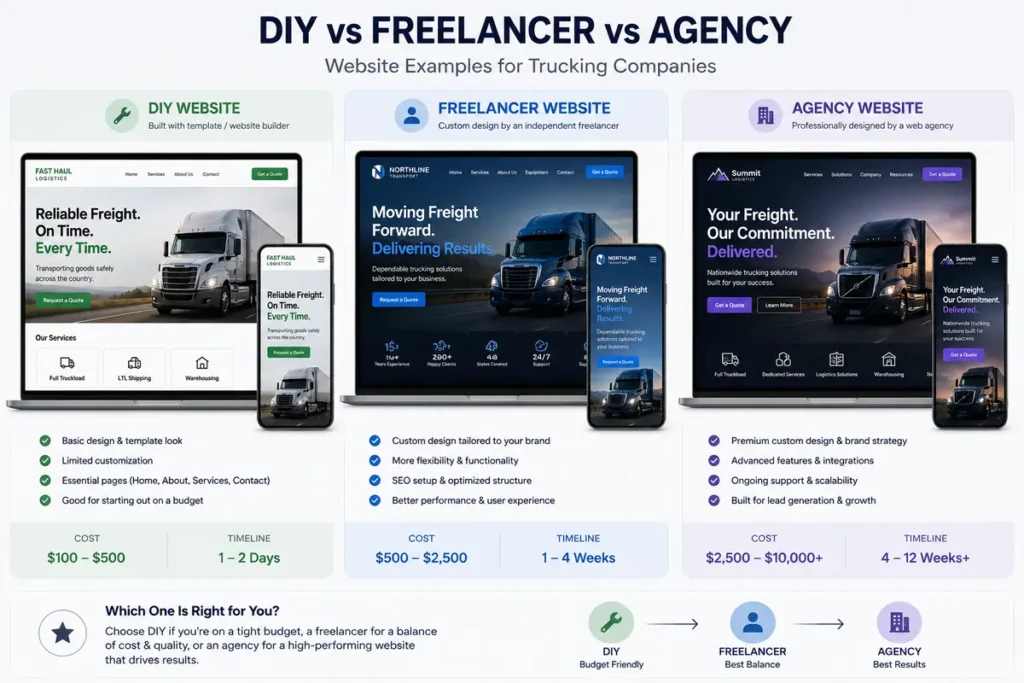
DIY vs Freelancer vs Agency {#diy-vs-agency}
| Option | Cost | Time to Launch | Skill Required |
| DIY (Wix/Squarespace) | $200–$600/year | 1–2 weeks | Low, but time-consuming |
| Freelancer | $500–$4,000 | 2–4 weeks | None from you |
| Agency | $3,000–$15,000+ | 3–6 weeks | None from you |
The tradeoff is almost always time versus money versus quality. DIY saves money but costs you hours you could spend running your business. Freelancers are a middle ground but quality varies wildly — you’re often hiring one person to be designer, writer, and developer at once. Agencies cost more upfront but usually include strategy, copywriting, and SEO as part of the process instead of as afterthoughts.
Hidden Costs Most Companies Forget {#hidden-costs}
- Domain renewal: usually $12–$20/year, easy to forget until it lapses
- SSL certificate renewal: often bundled with hosting, but not always
- Hosting renewal: some builders quote a low year-one price that jumps at renewal
- Email setup: a professional email (you@yourcompany.com) sometimes costs extra
- Content updates: changing your service area or adding a new lane isn’t always free
- DOT/MC number updates: needed if your authority status changes
- Eventual redesign: template sites often need a full rebuild within 12–24 months as the business outgrows them
None of these individually break the bank, but they add up over a year or two — and they’re rarely mentioned upfront.
Features Every Trucking Website Should Include {#must-have-features}
- Clear headline stating what you haul and where
- MC/DOT number visible (builds instant credibility with brokers and shippers)
- Service area and lanes clearly listed
- Equipment types (dry van, reefer, flatbed, hotshot, etc.)
- A quote request form that’s easy to fill out Click-to-call phone number, especially on mobile
- Real photos of your trucks and equipment A short, honest “About” section — experience, safety record, years in business
- Mobile-friendly design (most traffic to small business sites is mobile)
- Fast page load speed
- SSL certificate (the padlock icon — Google and visitors both expect it)
- Google Business Profile link
Features That Aren’t Worth Paying Extra For {#skip-features}
- Live chat bots, if nobody on your team can actually monitor them
- Heavy animated intros or video backgrounds that slow load speed
- Generic “corporate” stock photos instead of real trucks and real people
- An overly complex custom CMS for a simple 5-page site
- A blog you have no plan to maintain
- Multiple language versions you don’t currently need
These features sound impressive, but rarely move the needle for a trucking company’s actual goal: getting the phone to ring.
ROI Example {#roi}
Here’s a simple way to think about it. Say a website costs $3,000, and it helps you land just one new shipper or broker relationship that’s worth $2,000 in monthly freight. That website pays for itself in under two months — and keeps generating value every month after that.
Even a modest site that brings in one solid lead every few months usually outperforms its own cost within the first year. The real risk isn’t spending too much on a website — it’s spending money on one that never generates a single lead because it has no trust signals, no clear call to action, and nothing that separates it from a hundred other generic trucking pages.
See how our website packages compare if you want a clearer picture of what’s included at each price point.
Real Pricing Scenarios {#scenarios}
Owner Operator Just got your authority, running solo. A simple 3–5 page DIY or freelancer site ($500–$1,500) covering your services, equipment, and contact info is usually enough at this stage.
Small Fleet 2–10 trucks, actively trying to build direct relationships with shippers. A custom freelancer or small agency build ($1,500–$5,000) with basic SEO and a real quote form makes sense here.
Medium Carrier 10–50 trucks, competing for larger contracts. An agency site with SEO, copywriting, and local search optimization ($5,000–$10,000) helps you look — and rank — like the established company you are.
Large Fleet 50+ trucks, multiple service areas or states. A larger custom build with multiple location pages, advanced SEO, and CRM integration ($10,000–$15,000+) supports the scale of the operation.
Common Mistakes {#mistakes}
- Choosing the cheapest option without checking what’s actually included
- Skipping SEO entirely, then wondering why the site never shows up in search
- Using a generic template with no real photos, no MC/DOT number, and no trust signals
- Burying the quote request form instead of making it easy to find
- Ignoring the mobile experience, when most visitors are on their phones
- Forgetting to budget for hosting, domain, and maintenance renewals
- Launching the site and never updating it again
How much should a trucking website cost?
Most small-to-mid fleets should budget $1,500–$6,000 for a professional site. Larger carriers with more complex needs often invest $5,000–$15,000+.
Can I build one myself?
Yes, especially if you’re a new owner-operator on a tight budget. DIY builders like Wix or Squarespace work fine for a simple 3–5 page site. Just know you’ll be doing the writing, design, and updates yourself.
Is WordPress good for trucking companies?
Yes, WordPress is a solid choice, especially if you want strong SEO control and room to grow. It requires more setup than a drag-and-drop builder, though.
Do trucking companies need SEO?
If you want shippers, brokers, or customers finding you through Google, yes. Without it, your site can still work as a digital business card, but it won’t generate inbound leads on its own.
How many pages should a trucking website have?
A minimum of 3–5: home, services, about, and contact. Adding dedicated pages for equipment types or service areas helps with SEO as you grow.
Can I get a trucking website under $500?
Yes, through DIY builders or basic freelancer templates. Just expect limited customization and no SEO or copywriting included.
What’s included in a typical trucking website package?
It depends on the provider, but a solid package usually includes design, a handful of pages, mobile optimization, a contact/quote form, and basic on-page SEO.
How long does it take to build a trucking website?
DIY sites can go live in 1–2 weeks. Freelancer builds typically take 2–4 weeks. Full agency builds with SEO and copywriting often take 3–6 weeks.
Is hosting included in the price?
Sometimes, sometimes not. Always ask directly — hosting is often billed separately on an annual basis.
Do trucking websites actually generate leads?
Yes, when they’re built with clear trust signals, a working quote form, and at least basic SEO. A site with none of these is closer to a digital business card than a lead-generation tool.
Should owner-operators have websites?
It depends on your goals. If you’re relying entirely on a dispatcher or load board, it’s optional. If you want direct shipper relationships or to look more established, a simple site helps.
How often should I update my trucking website?
At minimum, check it every few months for outdated info (DOT/MC status, service areas, contact details). A full refresh every 1–2 years keeps it looking current.
Conclusion {#conclusion}
Trucking website pricing varies because trucking websites aren’t one-size-fits-all. A new authority testing the waters needs something different than a 30-truck fleet competing for enterprise contracts. The goal isn’t to spend the most or the least — it’s to match the investment to what your business actually needs right now.
If you’re still not sure where you land, the fastest way to find out is to get a real, personalized quote instead of guessing based on price ranges alone.
Want to know what a website for your trucking business would actually cost? Tell us a little about your company, and we’ll provide a personalized quote with clear pricing and recommendations.
Request a Free Trucking Website Quote